Why Your Website Isn’t Ranking on Google is a common concern for new and growing websites.
You’ve optimized your pages, published content, and maybe even built a few backlinks — yet your website still doesn’t appear where it should. This situation is more common than most people realize, especially for new or growing websites.
Most websites fail to rank not because SEO is missing, but because search engines cannot confidently determine intent, topical focus or relative importance.
In most cases, SEO isn’t failing — search engines simply lack enough clarity to confidently interpret intent, trust or priority. Rankings don’t fail because of one big mistake. They stall because several small issues quietly stack up over time.
This guide breaks down the most common reasons websites fail to rank on Google and explains what actually needs attention first — based on how search engines evaluate pages today, not outdated assumptions. For a broader understanding of how SEO supports long-term visibility, refer to the Search Engine Optimization Guide 2026.
When SEO Effort Doesn’t Translate into Rankings
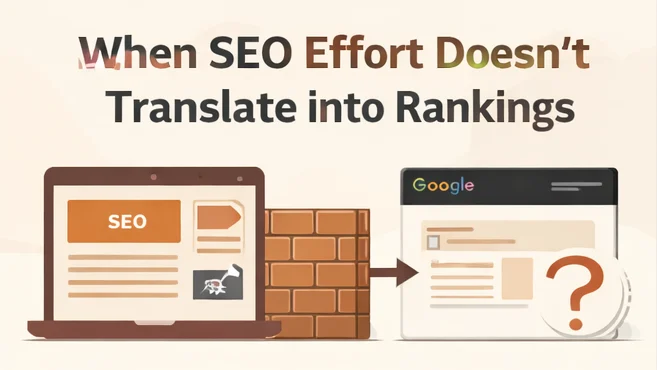
In most cases, ranking stagnation signals interpretational gaps rather than missing optimization. Lack of visible movement often leads to incorrect assumptions about SEO effectiveness. But ranking delays usually signal misalignment, not failure.
Some websites are indexed but not trusted. Others have content but miss intent. And many follow SEO checklists without understanding how all the pieces fit together. Until these gaps are addressed in the right order, visibility remains limited.
The sections below explain where things usually go wrong — and how to fix them strategically.
1. Your Website Is Indexed, but Google Doesn’t Trust It Yet
Indexing does not equal ranking. Many websites appear in Google’s index within days, but remain invisible for competitive queries.
This usually happens when:
- The site is new and lacks historical trust
- There are no strong authority signals
- Content exists, but does not stand out
Google needs reasons to prioritize a page. Until trust builds, rankings remain limited.
Google needs reasons to prioritize a page. Until trust builds, rankings remain limited.
This is why indexing and ranking are not the same process, even though they are often treated as interchangeable, as explained in Google’s official documentation.
2. Search Intent Is Mismatched
One of the most overlooked ranking issues is intent mismatch.
If a user is searching for solutions, but your page reads like a definition — Google will not surface it. Even technically optimized pages fail when the content does not align with what the searcher actually wants.
Common intent mismatches include:
- Informational content targeting transactional queries
- Generic explanations competing with problem-focused results
- Broad topics trying to rank for specific questions
Resolving these gaps requires intentional alignment between content format and search intent.
3. Why Content That Repeats Existing Results Doesn’t Rank
Publishing content alone rarely improves rankings without adding decision-level clarity for the reader. Google increasingly evaluates whether a page adds something new to the conversation. From a search perspective, information gain appears when a page clarifies decisions, removes confusion or resolves trade-offs better than existing results.
Websites struggle when:
- Content repeats what already exists
- Pages summarize instead of analyze
- There is no depth, analysis or practical resolution.
In competitive spaces, “good” content is average. Ranking requires clarity and differentiation.
4. Why Correct On-Page SEO Still Fails Without Strategic Alignment
Many sites follow on-page SEO checklists but still fail to rank. This usually happens when on-page elements are applied without understanding how they work together, which is explained in What Is On-Page SEO? How It Actually Works.
This happens when:
- Keywords are placed, but not supported contextually
- Headings exist, but don’t reflect real user questions
- Internal links are present, but not intentional
On-page SEO works best when structure supports understanding, not just optimization.
5. Technical Issues Are Quietly Blocking Performance
Technical SEO problems don’t always break a site — but they can quietly limit rankings.
Common technical blockers include:
- Slow LCP on content-heavy pages
- Poor INP affecting interaction
- Weak internal crawl paths
- Mobile usability inconsistencies
These issues rarely trigger penalties. Instead, they limit how far strong content can climb, even when relevance is clear.
6. Backlinks Exist, but Authority Is Still Weak
Not all links build authority. Many websites fail to rank despite having backlinks because those links lack relevance or trust. Authority strengthens when external signals align with internal topical depth.
Authority problems usually come from:
- Low-quality or unrelated links
- Inconsistent brand mentions
- No topical depth to support backlinks
Google evaluates context, not just quantity.
7. You’re Trying to Fix Everything at Once
One of the biggest SEO mistakes is lack of prioritization.
Websites stall when:
- Technical, content and link fixes are attempted together
- No clear sequence is followed
- Progress becomes difficult to measure
SEO works better when issues are fixed in order — not all at once.
What to Fix First: A Simple Priority Framework
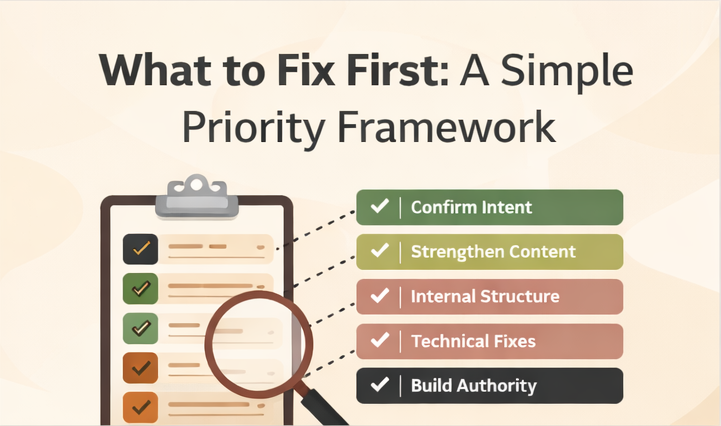
This sequence reflects how search engines evaluate pages, not a to-do list.
If your website isn’t ranking, start here:
- Confirm intent alignment
- Strengthen content clarity and depth
- Improve internal structure
- Fix technical bottlenecks
- Build authority gradually
Addressing issues out of sequence often masks root causes rather than resolving them.
Conclusion: Rankings Improve When Understanding Improves
Websites rarely fail because SEO is “not working.” They fail because search engines do not yet see enough clarity, trust or value.
If your website isn’t ranking on Google, the issue is rarely a single mistake but a combination of clarity, trust and prioritization gaps.
When structure is intentional, intent is clear and fixes are prioritized correctly, rankings begin to move. Not overnight — but consistently.
SEO is not about doing more. It is about improving clarity and priority before adding more tactics.
If your website is indexed but not progressing, this framework reflects how ranking diagnostics are evaluated before tactics are applied.
FAQs
1. Why is my website not ranking?
Websites usually fail to rank when SEO execution precedes intent alignment, trust signals and content clarity.
2. How long does SEO take to fix ranking issues?
Ranking movement typically becomes visible within 2–4 months once core issues are addressed in the correct order.
3. Do technical issues always affect rankings?
Technical issues do not always suppress rankings directly, but they often cap performance even when content relevance is clear.
4. Are backlinks necessary to rank?
Backlinks remain important, but relevance and contextual alignment influence rankings more than sheer volume.
5. Should I fix content or technical SEO first?
Content intent and clarity should be resolved before deeper technical optimization, as relevance precedes performance signals.
6. Why do new websites stagnate even with correct SEO?
New websites often stagnate because trust, historical signals, and topical depth take time to develop. Correct execution alone does not immediately translate into visibility without supporting authority and context.