Most students entering digital marketing hear the term “SEO” and immediately picture backlinks, domain authority and off-page tactics. But the foundation — the part that determines whether a page even deserves to rank — lives right on the page itself. Fixing these issues is the main goal of on-page SEO. And no, understanding it does not require a computer science degree. It requires attention, logic and a structured approach to how content, code and context come together.
This guide covers what is on page SEO from the ground up — every entity, every signal, every factor that search engines read before deciding where a page should sit in results. By the end, no questions should remain unanswered.
What Is On Page SEO — What This Actually Means
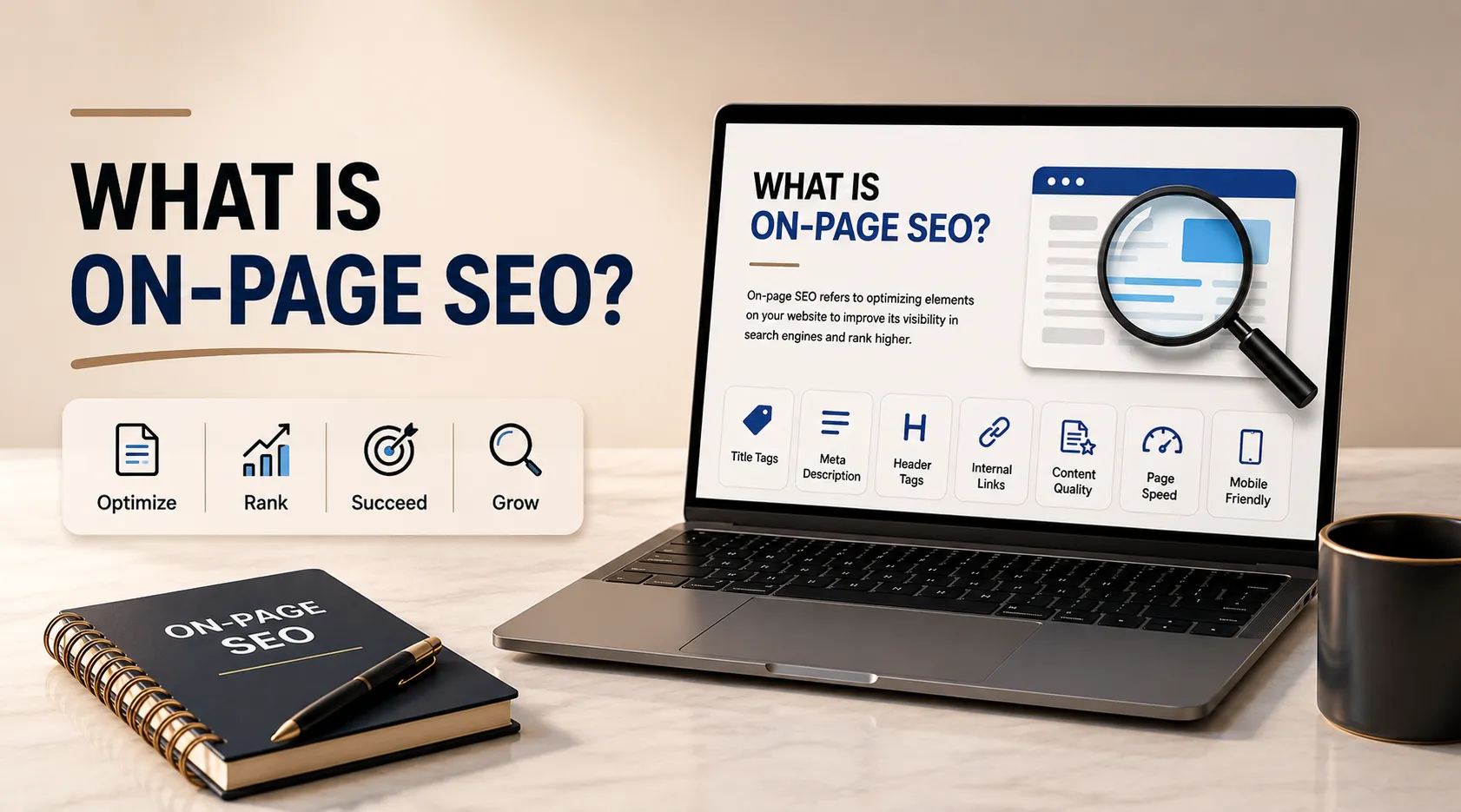
On page SEO refers to the practice of optimizing individual web pages — both their content and HTML source code — so that search engines can correctly understand, index and rank them for relevant queries. Every change made directly on the page, from the title tag to the last internal link, falls under on page SEO.
The term distinguishes this discipline from off-page SEO (link building, brand mentions, social signals) and technical SEO (crawlability, site speed, indexing infrastructure). On page SEO explained in the simplest possible terms: it is everything a page author controls directly, on that page, to communicate relevance and value to search engines and readers alike.
Key distinction: Off-page SEO builds authority through external signals. On page SEO builds relevance through internal signals. Both matter — but on page must come first. A page that Google cannot understand will never benefit from backlinks.
| SEO Type | Controlled By | Primary Goal | Examples |
|---|---|---|---|
| On Page SEO | Page author / webmaster | Relevance signals | Title tags, content, headings, internal links |
| Off Page SEO | Third-party sites | Authority signals | Backlinks, brand mentions, reviews |
| Technical SEO | Developers / webmasters | Crawlability + indexing | Sitemaps, Core Web Vitals, canonical tags |
Why On Page SEO Matters More Than You Think
Why on page SEO matters is not a rhetorical question for advanced practitioners — it is the first thing every marketer must grasp. Google uses many signals to rank websites, but on-page SEO is one of the easiest ways to show what a page is about. Without proper optimization, ranking for competitive keywords becomes much harder.
68%
of all internet traffic kicks off with a search engine
75%
of people never bother looking past the first page of results
3.5×
more organic traffic for pages with optimized title tags
53%
of web traffic is driven purely by organic search results
Consider this: a new blog article published on a mid-authority website, optimized correctly for on page SEO factors, will regularly outperform an older article on a stronger domain that was never properly optimized. Content optimization for SEO is the great equalizer — it rewards effort over seniority.
“Ranking higher isn’t about shouting the loudest—it’s about being the easiest to understand.”
Before optimizing your content, it’s crucial to understand what not to do. Many webmasters unknowingly sabotage their rankings by repeating easily avoidable blunders; studying a complete list of Common On-Page SEO Mistakes can save you months of wasted effort.
How On Page SEO Works — The Mechanism Behind Rankings
Understanding how on page SEO works requires a brief look at what happens when Google crawls a page. Googlebot visits the URL, renders the HTML (including JavaScript where applicable), and reads every element on the page. The crawler then extracts signals related to topic, entity relevance, content quality, user experience, and keyword context — all of which feed into ranking decisions.
The Crawl-to-Rank Pipeline
Crawling: Googlebot discovers the URL via a sitemap or internal link, then downloads the page content.
Rendering: The page is rendered with a browser-like engine to process JavaScript and dynamic content.
Indexing: Signals from the rendered page — title, headings, content, schema markup, meta description — are extracted and stored.
Ranking: Pages compete for query-relevant positions based on their on-page and off-page signals combined.
Re-evaluation: Pages are re-crawled periodically — meaning on page improvements produce ranking shifts over time.
On page SEO influences steps 2 through 4 directly. Every title tag, every heading, every word in the body copy sends a relevance signal to the indexing engine. This is precisely how on page SEO works at a mechanical level — structured communication between the page and the algorithm.
On Page SEO Factors — Complete Breakdown
The complete list of on page SEO factors covers far more ground than most beginners expect. The table below maps every major factor to its function and priority level.
| Factor | What It Controls | Priority |
|---|---|---|
| Title Tag | Page title shown in SERPs; primary keyword signal | Critical |
| Meta Description | SERP snippet copy; influences click-through rate | High |
| H1 Heading | Primary topic declaration; one per page | Critical |
| Subheadings (H2–H6) | Content hierarchy; secondary keyword placement | High |
| URL Structure | Clean, descriptive slugs for crawling and UX | High |
| Keyword Placement | Keyword in first 100 words, throughout content naturally | Critical |
| Content Depth | Topical completeness; covering all related entities | Critical |
| Image Alt Text | Descriptive text for images; accessibility + indexing | Medium |
| Internal Links | Distributes PageRank; signals related content clusters | High |
| Schema Markup | Structured data; enables rich results in SERPs | High |
| Page Speed (CWV) | Core Web Vitals; part of page experience ranking signal | Critical |
| Mobile Responsiveness | Mobile-first indexing compliance | Critical |
| Outbound Links | Citations to authoritative sources; trust signal | Medium |
| Canonical Tag | Prevents duplicate content indexing issues | High |
| E-E-A-T Signals | Experience, Expertise, Authoritativeness, Trustworthiness | Critical |
Keeping track of all these elements during production can be overwhelming. To ensure you never miss a critical optimization step before hitting publish, it is highly recommended to follow a structured On-Page SEO Checklist that streamlines your entire workflow.
Heading Structure for SEO — H1 to H6 Done Right
The heading structure for SEO is one of the most misunderstood factors among new marketers. Headings are not decorative formatting — each level tells search engines something specific about content hierarchy and topic relationships.
What Each Heading Level Communicates
Common Mistake
Using multiple H1 tags on one page confuses search engines about the primary topic. Similarly, jumping directly from H2 to H4 without an H3 breaks logical hierarchy and weakens content structure.
A correct heading structure also directly improves readability — which Google measures indirectly through user behavior signals like dwell time and bounce rate. When people can quickly find what they are looking for on a page, it often performs better in search results.
Content Optimization for SEO — Quality That Google Rewards
Content optimization for SEO goes well beyond inserting a keyword every 300 words. Google’s algorithms, particularly the Helpful Content Update and the evolution of RankBrain and BERT, now evaluate content on a semantic level — meaning topical completeness, entity coverage, and genuine helpfulness carry far more weight than keyword density.
What Makes Content Genuinely Optimized?
Search Intent Match: Informational queries demand detailed explanations. Transactional queries demand clear offers. Navigational queries demand direct access. The content format must mirror the intent.
Entity Coverage: A page about on page SEO should mention related entities — title tags, meta descriptions, keyword research, schema markup, E-E-A-T, and Core Web Vitals. Google’s Knowledge Graph cross-references these entities.
Keyword Placement Rules: Primary keyword in the H1, first paragraph, at least two H2s, image alt text, meta title, and meta description. Secondary keywords distributed naturally across body copy.
Content Length: Longer is not always better. Comprehensive is better. A 1,200-word article that fully answers a query often outperforms a 3,000-word article padded with repetition.
Readability: Short sentences, active voice, clear paragraph breaks, bullet points and tables for scannable formatting. Flesch-Kincaid score above 60 is a practical benchmark.
Freshness Signals: Content updated regularly with new data, statistics, or expanded sections performs better over time than static pages that were published and forgotten.
E-E-A-T: Author bylines, citations to credible sources, factual accuracy, and original insights signal expertise and trustworthiness — factors Google weighs heavily in YMYL (Your Money, Your Life) categories.
Internal Linking for SEO — The Silent Authority Builder
Ask most students about internal linking for SEO and the typical answer is “link to related pages.” That answer is not wrong — but it misses two-thirds of the story. Internal linking serves three distinct functions simultaneously: it distributes PageRank across the site, signals topical clusters to search engines, and guides users through a logical content journey.
Internal Linking Best Practices
| Practice | What It Does | Example |
|---|---|---|
| Use descriptive anchor text | Tells Google the context of the linked page | “Learn about keyword research” — not “click here” |
| Link from high-authority pages | Passes more link equity to target pages | Homepage or popular pillar page → new article |
| Create content clusters | Groups topically related pages; strengthens topical authority | Pillar page on SEO → cluster pages on each sub-topic |
| Avoid orphan pages | Ensures every page is discoverable via internal links | Every new article linked from at least one existing page |
| Limit links per page | Prevents link dilution; keeps PageRank concentrated | 3–7 contextual internal links per article is a reasonable range |
Agencies like Social Emage consistently demonstrate that clients who restructure internal linking around topic clusters see measurable ranking improvements within 60–90 days — without any additional backlink acquisition. The signal was always there; the architecture just needed to communicate it clearly.
On Page SEO Explained — Common Mistakes That Kill Rankings
On page SEO explained thoroughly must include the errors that undo otherwise solid work. The list below covers the most frequent problems found during SEO audits — many of which are fixable within hours.
Keyword Stuffing
Repeating the keyword unnaturally. Google’s spam filters flag this — and readers notice immediately.
Duplicate Title Tags
Two pages with the same title compete against each other and confuse Google’s indexing logic.
Missing Alt Text
Images without alt attributes are invisible to search engines — wasted indexing opportunity.
No Internal Links
Orphan pages receive no PageRank and rarely rank. Every page must connect to the internal architecture.
Thin Content
Pages under 400 words rarely satisfy search intent. Google’s Helpful Content system filters these out.
Slow Load Times
Core Web Vitals (LCP, FID/INP, CLS) are confirmed ranking signals. Speed is an on page SEO factor.
What Is On Page SEO in Practice — A Quick-Reference Checklist
Before publishing any page, run through the checklist below. This is the operational version of everything covered in this guide — the difference between knowing what is on page SEO and actually executing it correctly.
Title tag includes primary keyword, under 60 characters, unique across the site
Meta description is 150–160 characters, includes keyword naturally, has a clear value proposition
One H1 per page — contains primary keyword — matches or complements the title tag
H2s cover all major sub-topics; H3s break those down further where necessary
Primary keyword appears in first 100 words
All images have descriptive alt text — no images with alt=”” unless purely decorative
3–5 internal links with descriptive anchor text pointing to related content
At least 2 outbound links to authoritative sources (studies, official documentation, trusted publications)
URL slug is short, keyword-inclusive, and uses hyphens (not underscores)
Schema markup is implemented (Article, FAQ, or HowTo where applicable)
Page passes Core Web Vitals (LCP < 2.5s, CLS < 0.1, INP < 200ms)
Content fully answers the search intent — no significant sub-topic left unaddressed
Final Verdict
What is on page SEO, stripped down to its core? It is the discipline of making a web page perfectly legible to both humans and search engines at the same time. Every factor covered in this guide — heading structure for SEO, content optimization for SEO, internal linking for SEO, title tags, schema markup, Core Web Vitals — serves that single purpose.
For students entering digital marketing, on page SEO is the ideal starting point. The feedback loop is fast, the tools are accessible (Google Search Console, Screaming Frog, Ahrefs Webmaster Tools — all free at entry level), and the results are measurable within weeks. Agencies like Social Emage that specialize in SEO execution build their entire workflow around getting on page fundamentals right before scaling any campaign.
On page SEO explained correctly is not a list of hacks. It is a systematic commitment to clarity — making sure every page earns its ranking position through substance, structure, and relevance. Start with one page. Apply every factor from the checklist above. Measure. Iterate. That is how professionals actually work.
SEO success does not come from tricks. It comes from consistently making pages easier for both users and search engines to understand.
FAQs
1. What is on-page SEO in simple terms?
On-page SEO is the process of structuring content and page elements to clarify what a page represents and when it should appear.
2. Why does on-page SEO matter for rankings?
Because it reduces ambiguity. Clear content structure and intent make relevance easier to assess.
3. Is on-page SEO just about keywords?
No, Keywords are signals. On-page SEO prioritizes clarity, structure and intent rather than placement.
4. Can on-page SEO alone improve rankings?
On-page SEO sets the foundation. It makes rankings possible, but long-term growth also depends on authority, trust and overall site quality.
5. Why do on-page SEO checklists often fail?
Because they focus on tasks, not understanding. When elements are applied without intent, elements may exist, but the page’s purpose remains unclear.
6. How does internal linking support on-page SEO?
Internal links provide context about topic connections and page importance.