Headings are highly visible on any web page, but their role is often misunderstood. Even when H1, H2 and H3 tags are present, ranking improvements may not follow. This typically happens due to unclear implementation rather than missing headings. A well-defined heading structure for SEO supports better understanding of the page’s focus and organization for both users and search engines.
Instead of treating headings purely as decorative elements, it is better to recognize them as structural markers. They separate content into organized sections and signal which ideas deserve more emphasis. Thoughtful heading planning improves scannability and overall readability. Such clarity contributes to sustainable growth, aligning with the principle behind SEO Off Page Optimization Basics for Long Term Growth, where structure and discipline are valued over shortcuts.
Why Headings Matter for SEO
Headings guide attention. They tell readers what to expect in the next section and help search engines understand topic hierarchy. This is one reason why headings matter for SEO beyond simple formatting.
Search engines use headings to detect context. If a page discusses multiple subtopics, headings help separate them clearly. Without structure, content may look like a single block of text, even if the information itself is useful.
A well-structured and SEO friendly heading structure supports stronger readability. When a page is easy to scan and users can identify useful sections quickly, engagement follows. The goal is not just to insert keywords, but to improve clarity throughout the content.
Poor structure often connects to broader layout problems. The discussion in Why Content Alone Doesn’t Rank Without Structure highlights how even strong writing struggles when hierarchy is unclear.
H1 H2 H3 Tags Explained
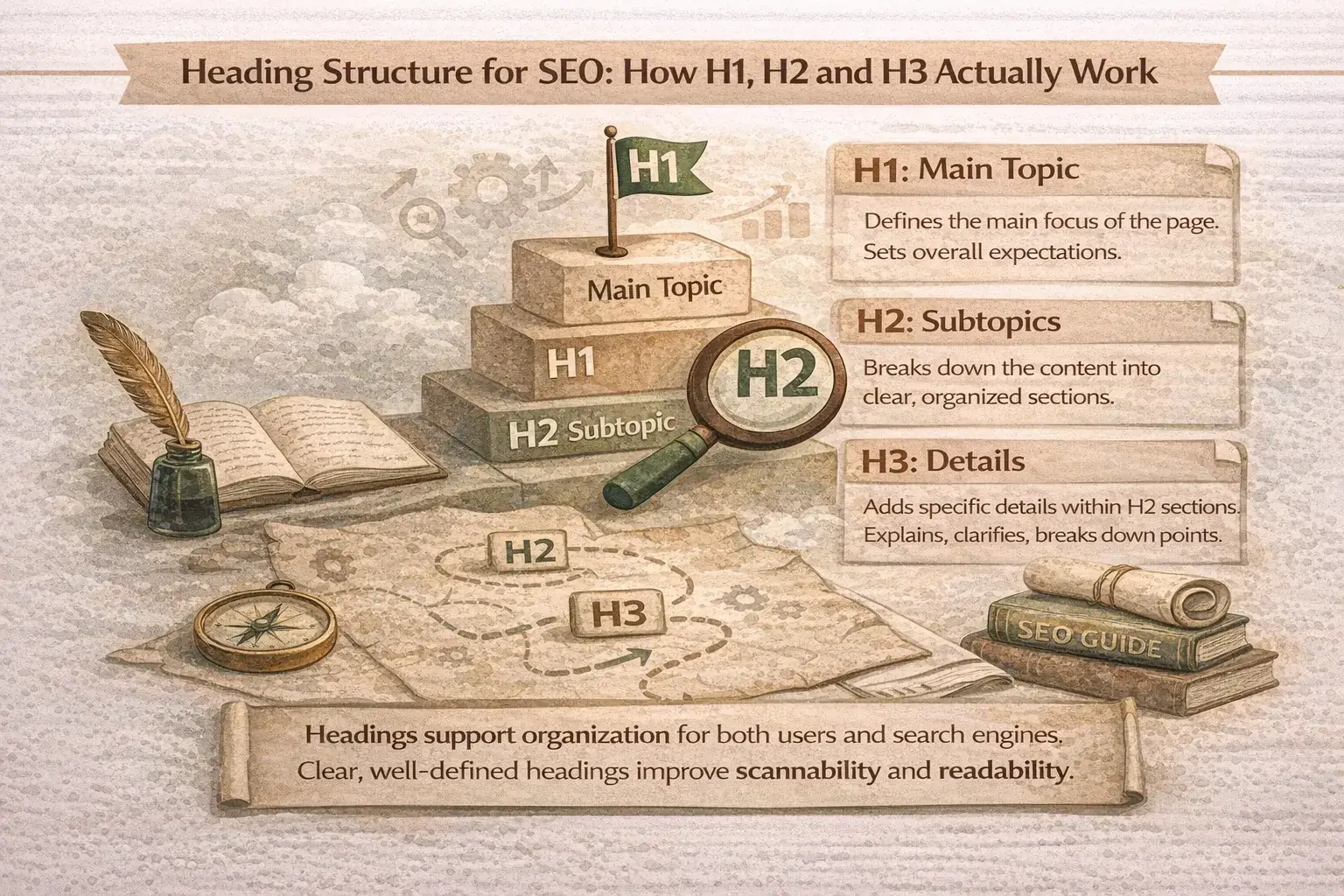
Understanding hierarchy makes everything simpler. In basic terms H1, H2 and H3 tags explained in order would look like this:
- H1 represents the main topic of the page.
- H2 breaks the topic into primary sections.
- H3 supports sub-points within an H2 section.
There should generally be only one H1 per page. It defines the central theme. Multiple H1 tags can dilute clarity and make the page structure confusing.
H2 headings act as the main content divisions. Each one should represent a distinct idea connected to the primary topic. H3 headings provide further explanation where needed, but they should not exist without an H2 above them.
A strong heading structure for SEO follows logical order rather than visual preference. Skipping levels or using headings only for styling disrupts the hierarchy.
How to Use Headings for SEO
The process of learning how to use headings for SEO begins with clear planning. Adding headings after the draft is written is less effective than organizing sections at the outline stage.
Start with the core topic as the H1. Then identify 4–6 major subtopics that naturally support it. These become H2 headings. If a section needs deeper clarification, introduce H3 headings carefully.
Headings should:
- Clearly describe the section content
- Stay relevant to the main topic
- Avoid unnecessary repetition
When considering how to use headings for SEO, it is important not to overload them with variations of the same keyword. Repetition does not strengthen structure; it often weakens it.
The relationship between content depth and structure is also discussed in Content Length vs Rankings: What Actually Matters. Longer content only works well when organized properly.
Heading Mistakes in SEO
Many pages contain heading mistakes in SEO that go unnoticed. These errors may not cause penalties, but they reduce clarity.
One common mistake is using headings purely for styling. Enlarging text visually without proper hierarchy confuses the document structure. Another issue is repeating similar headings across multiple sections without adding new context.
Skipping heading levels is another structural flaw. For example, moving from H1 directly to H3 breaks logical flow. It signals inconsistency in content organization.
Keyword stuffing inside headings is also problematic. When headings are overloaded with search phrases, they appear forced and unnatural. A clean SEO friendly heading structure focuses on clarity first.
Regular review helps spot these heading mistakes in SEO before publication. Structured checklists, including the approach discussed in On-Page SEO Checklist That Actually Works, can simplify the review process.
SEO Friendly Heading Structure
An SEO friendly heading structure balances hierarchy and readability. It does not attempt to impress search engines with complexity. Instead, it aims for logical sequencing.
Each H2 should represent a meaningful section that could stand alone if needed. H3 headings should clarify, not fragment, the topic. When headings feel disconnected from the content below them, the structure likely needs revision.
A strong heading structure for SEO also ensures alignment with search intent. Informational content should guide readers step by step, while avoiding unnecessary diversions.
Consistency matters more than strict rules. Pages do not need a fixed number of headings. They need coherence. When hierarchy feels natural and predictable, users navigate content more comfortably.
Over time, this approach builds authority gradually. On platforms like Social Emage, where the focus is on learning and structured improvement, refining heading practices becomes part of steady development rather than quick optimization.
Conclusion
Heading structure is less about technical complexity and more about logical organization. Understanding H1 H2 H3 tags explained in hierarchy form helps maintain clarity across sections. Avoiding heading mistakes in SEO and learning how to use headings for SEO with intention supports better readability and alignment.
A clean heading structure for SEO strengthens both user experience and contextual clarity. When headings are used as structural markers rather than decorative elements, content becomes easier to follow and assess. Over time, a consistent hierarchy and well-planned organization support steady, long-term growth without depending on shortcuts.
FAQs
1. How many H1 tags should a page have?
Generally one is enough because it defines the main topic clearly. Adding multiple H1 tags can blur focus and weaken the overall hierarchy of the page.
2. Do headings directly improve rankings?
Not on their own. They help search engines understand structure and context, which supports clarity, but rankings depend on multiple combined factors.
3. Can I skip H2 and go straight to H3?
Skipping levels breaks logical flow. Headings work best when they follow order, so H3 should only appear under a related H2 section.
4.Is repeating keywords in headings a good idea?
Overusing keywords inside headings often makes them look forced. Clear, descriptive phrasing usually works better than repetition.
5. Why does heading structure matter for long articles?
Extended pages can be challenging to scan if hierarchy is not maintained. Clear headings segment the content into digestible sections and prevent it from appearing too dense.
6. Does design matter more than heading tags?
Visual design helps readability, but structural tags define hierarchy for search engines. Both should align rather than compete with each other.