On-page SEO is one of the most followed parts of SEO—and also one of the most misunderstood. Most websites believe their on-page SEO is “done.” Titles are written, keywords are placed, headings are added,and internal links exist. Yet rankings don’t move.
That gap between effort and outcome is not accidental.
On-page SEO doesn’t fail because steps are skipped. It fails because those steps are applied without understanding why they exist. A checklist only works when the logic behind it is clear. This is why understanding what on-page SEO actually is matters before applying any checklist. Otherwise, pages look optimized but remain irrelevant to search engines.
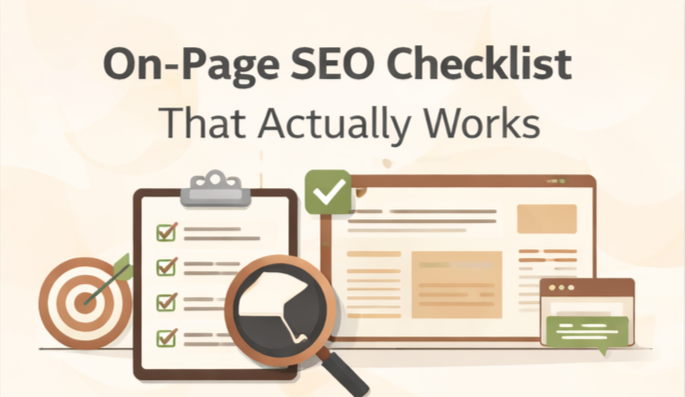
This checklist is not about ticking boxes. It is about correcting the signals that actually influence how a page is interpreted.
1. Start With One Clear Page Purpose
Most on-page SEO problems begin here.
Pages often try to rank for multiple ideas at once. One section explains a definition, another attempts to solve a problem and a third compares tools. From a search engine’s perspective, the page lacks direction.
Before any optimization, answer one question clearly:
What is this page supposed to rank for?
If the answer is vague, no checklist can meaningfully help. Strong on-page SEO begins when a page focuses on a single intent and builds all elements around it.
For example, a page targeting an on-page SEO checklist should not also explain backlink tools or pricing models. Mixing intents weakens relevance and confuses search engines.
2. Write the Title for Meaning, Not Variations
Titles are frequently overloaded. Multiple keyword variations are pushed into a single line in the hope of covering more ground. In reality, this weakens the signal. Many of these patterns appear repeatedly in common on-page SEO mistakes.
A strong title does two things:
- It reflects the primary intent of the page
- It sets clear expectations for the reader
When a title tries to target too much, relevance drops. Search engines prefer clarity over coverage.
If a title needs more than one sentence to explain, it is usually taking on too much.
3. Use Headings to Define Structure, Not Formatting
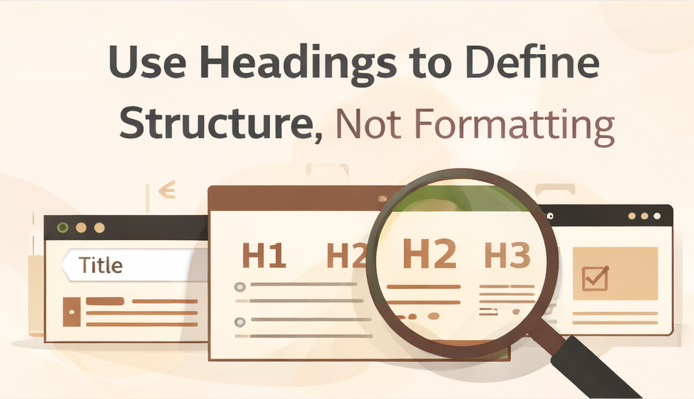
Headings are often treated as design elements. They exist to break text visually, not to communicate hierarchy. This is a mistake that appears frequently.
Headings act as one of the strongest on-page signals for SEO. They help search engines understand how information is organized and which points matter more.
Effective headings:
- Follow a logical flow
- Reinforce the main topic
- Reflect how users actually search
A page can lose structural clarity when headings are generic or disconnected, despite having solid content.
4. Align Content With Search Intent
Content optimization for SEO fails most often because intent is misread.
A page written like a tutorial will not rank for a problem-based query. A definition-style page will struggle where users expect practical guidance. Search engines detect this mismatch through user behavior.
On-page SEO works when content matches the reason behind the search, not just the words used.
For users seeking guidance, surface-level explanations do not provide enough clarity. If they are researching, aggressive advice feels misplaced.
Intent alignment is not optional. It is foundational.
5. Avoid Keyword Placement Without Context
Keywords still matter. But placement without context creates noise.
Many pages include keywords in titles, headings and paragraphs, yet still feel unclear. That happens when keywords are inserted without supporting meaning. Search engines do not judge keywords independently, but instead look at how effectively they are supported by the surrounding content.
Good on-page SEO uses keywords as anchors, not crutches.
The page should still make sense even if the keyword is removed.
6. Build Depth Without Losing Focus
Longer content is often mistaken for better content. In reality, unfocused depth is worse than concise clarity.
Pages that try to answer every related question often dilute their core message. Search engines identify this through topic drift—when sections move away from the original intent.
Effective on-page SEO keeps depth relevant. Every section should support the same idea, rather than adding something new unless it clearly serves the page’s purpose.
7. Use Internal Linking to Confirm Relevance
Internal linking for SEO is not about navigation. It is about context.
Internal links help search engines understand:
- Which pages matter most
- How topics are connected
- Where authority should flow
Pages without internal links stand alone. Pages with thoughtful internal links gain context. This becomes especially important for newer content that relies on stronger pages for visibility.
When working on content projects at Social Emage, internal linking consistently played a role in helping search engines interpret content clusters more accurately—not through volume, but through relevance.
8. Check for Conflicting Signals
One of the most overlooked on-page SEO issues is contradiction.
This usually happens when:
- The title suggests one intent, but the content follows another
- Headings imply breadth, but the content stays shallow
- Keywords point in one direction, while internal links suggest another
Search engines do not “average” signals. Conflicting signals reduce confidence.
When confidence drops, rankings stall. This is also why many websites struggle to rank despite basic optimization.
On-page SEO performs better when all elements move in the same direction.
9. Remove What Does Not Support the Page Goal
Optimization is not always about adding. Often, it is about removing.
Extra sections, loosely related paragraphs or unnecessary explanations weaken focus. Pages improve when irrelevant content is cut, not expanded.
A clean page with clear intent consistently outperforms a bloated page with scattered relevance.
10. Why On-Page SEO Often Appears to Not Work
When on-page SEO is said to “not work,” it is often a different issue being described.
What actually fails is:
- Mechanical execution
- Blind checklist usage
- Optimization without intent
On-page SEO is not outdated. It is frequently misapplied. Pages look optimized but fail to communicate meaning. Without meaning, search engines hesitate. Without confidence, rankings do not move.
Conclusion: A Checklist Works Only When Strategy Is Clear
An on-page SEO checklist is useful only after there is a clear understanding of how on-page SEO actually works. Without that understanding, optimization becomes guesswork.
The goal of on-page SEO is not to satisfy a tool or complete a list. It is to make a page unmistakably clear—about its purpose, relevance and value.
Without clarity, optimization adds noise.
With clear structure and intent, rankings finally have a solid reason to improve.
FAQs
1. What is an on-page SEO checklist?
An on-page SEO checklist is used to review whether a page is properly structured and easy to understand. It helps identify clarity gaps before expecting rankings.
2. Is on-page SEO enough to rank on Google?
On-page SEO sets the base, while long-term rankings depend on authority, trust and overall site quality.
3. Why do on-page SEO checklists fail?
They fail when steps are followed mechanically. Without clear intent and structure, optimization does not translate into rankings.
4. Should beginners follow an on-page SEO checklist?
Yes, but this approach works only when the purpose and role of each step are clear from the start.
5. Does internal linking really matter for on-page SEO?
Yes. Internal linking helps provide context across related content. It helps search engines understand page relationships and identify which content matters most.