Search Engine Optimization is frequently reduced to ranking tactics, even though its real role is to help search engines accurately interpret and surface content.
In recent years, SEO has evolved more than many people realize. Many ranking methods used in 2020 no longer work today. Yet, a large part of the industry is still stuck chasing the same shortcuts — keyword stuffing, link counts and ranking tricks.
In practice, SEO has little to do with “gaming” search engines. It is about reducing ambiguity so search systems can correctly interpret content. Across multiple SEO implementations at Social Emage, a consistent pattern emerges: websites struggle not due to a lack of tactics, but because search engines fail to clearly interpret what the content represents.
In reality, rankings are only the outcome. SEO starts much earlier — with structure, intent and relevance. This guide breaks down SEO from that perspective, without hype or shortcuts and explains what actually drives sustainable growth.
What Is SEO? Moving from Keywords to Intent
For years, SEO was framed around placing keywords in specific locations. That explanation does not fit current search engine evaluation methods.
Today, SEO centers on relevance and accessibility. Search engines rely on language-understanding systems to grasp context and intent, moving beyond simple word matching.
Key signals that matter in 2026 include:
- Semantic Depth: Does the content genuinely satisfy the reason behind the search?
- Structural Integrity: Is the information logically organized so search engines can classify it correctly?
- Experience Metrics: Does the page load quickly, remain stable and respond smoothly to user interactions?
At Social Emage, keyword usage is treated as a supporting signal rather than a primary optimization strategy. They function as signals, not strategies. Pages performed better when the priority moved toward becoming the most useful and trustworthy response to a specific query.
How Search Engines Work: The Three-Stage Life cycle
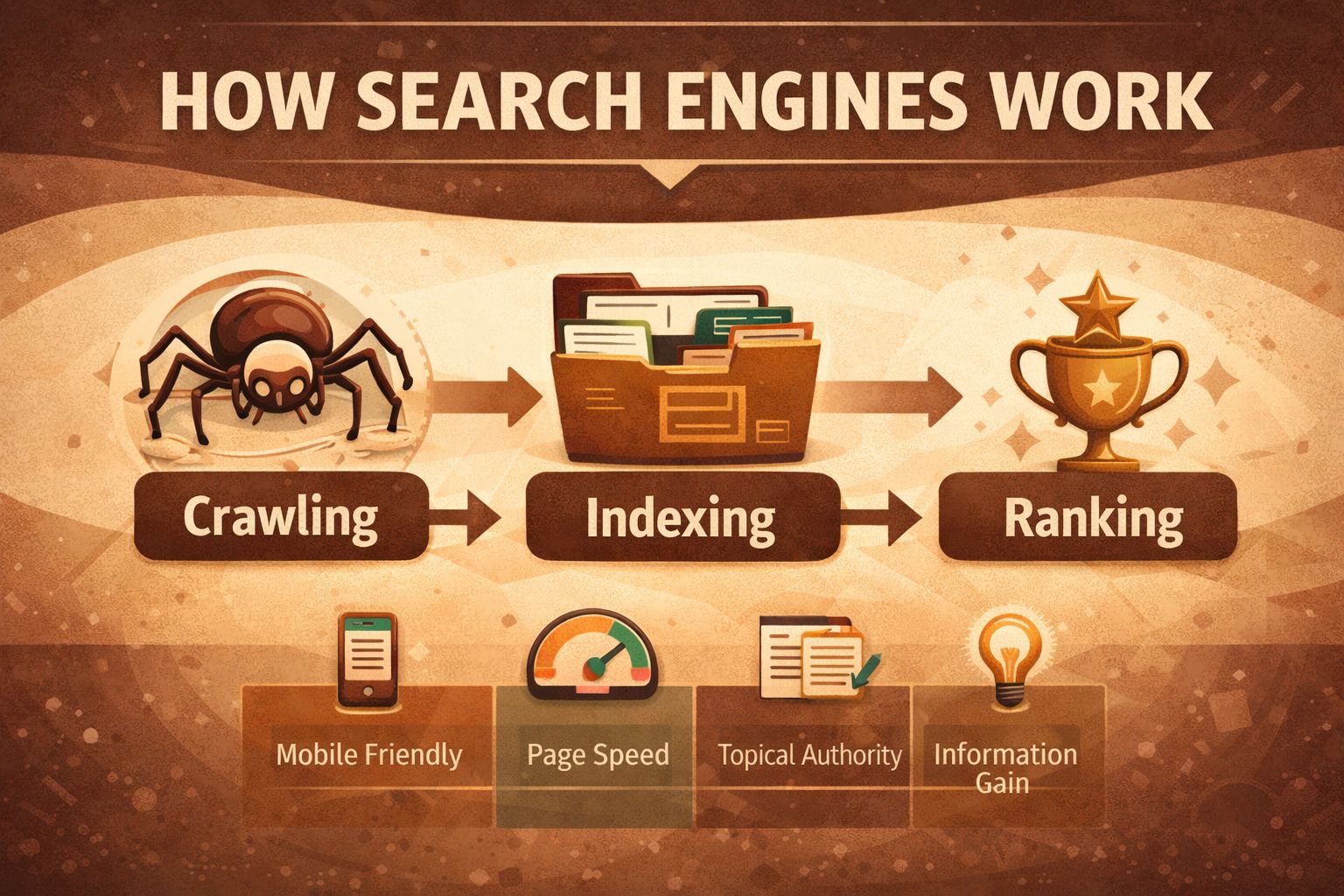
Behind every search result is a simple but structured process. Understanding this removes much of the confusion around SEO.
1. Discovery (Crawling)
Search engines rely on automated bots to find new and updated content. These bots move through links, sitemaps and site structures. Unclear navigation or weak internal linking can cause important pages to be missed or discovered later.
A clean structure makes crawling efficient. A messy one creates invisibility.
2. Categorization (Indexing)
After a page is found, search engines examine its content, structure and supporting signals to decide how it should be categorized and when it can surface in search results.
Clearer heading structures and structured data signals have consistently helped search engines index pages more accurately across SEO work at Social Emage. Lower ambiguity improves how clearly search engines can identify what a page represents.
3. Evaluation (Ranking)
When a search is performed, Google retrieves relevant pages from its index and evaluates them using hundreds of signals. These include mobile usability, page performance, topical authority and information gain.
Pages that offer clarity, originality and real insight consistently outperform content that simply repeats what already exists — even if that content is technically optimized.
The Practical Pillars of SEO Strategy
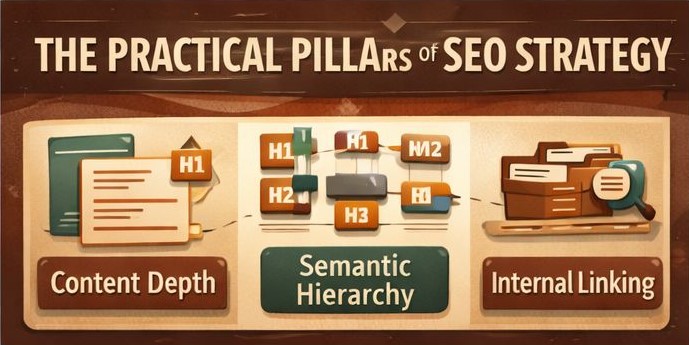
Strong SEO is shaped by connected elements, not standalone actions. For a step-by-step implementation, refer to the On-Page SEO Checklist That Actually Works.
A. Content Depth and Intent
Publishing more content does not guarantee better results. Publishing the right content does.
Search intent generally falls into four categories:
- Informational: Users looking to understand or solve something.
- Navigational: Users searching for a specific brand or platform.
- Commercial: Users comparing options before making a decision.
- Transactional: Users ready to take action.
Content performs better when it serves one defined intent rather than several competing ones.
B. The Semantic Hierarchy (H1, H2, H3)
Headings are not just formatting tools. They communicate structure and relationships between ideas.
- H1 defines the main topic.
- H2 breaks the topic into key sections.
- H3 supports those sections with detail.
When headings reflect real user questions, both engagement and clarity improve. This alignment alone often reduces bounce rates significantly.
C. Internal Linking: The Web of Authority
Internal links help distribute authority across a website. They guide users, support crawling and signal which pages carry importance.
When internal links are structured properly, established pages help lift newer or supporting content instead of leaving pages isolated.
Categorizing Search Engine Optimization
Breaking SEO into clear categories makes execution more manageable.
| SEO Type | Focus Area | Essential Tasks |
| On-Page SEO | Content & HTML | Contextual keywords, metadata, schema |
| Off-Page SEO | Trust & Authority | Backlinks, brand signals, E-E-A-T |
| Technical SEO | Backend Health | Core Web Vitals, HTTPS, mobile optimization |
Each category strengthens the others. Ignoring one creates imbalance.
Beginner Misunderstandings: Lessons from the Field
Certain mistakes appear repeatedly in early SEO efforts:
- The Checklist Fallacy: SEO is not a one-time task. It requires monitoring and adjustment.
- Over-Optimization: Writing for algorithms often drives users away.
- Speed Obsession: Performance helps, but it cannot replace substance.
These issues cost time and resources before the fundamentals are understood.
Many websites struggle due to basic SEO mistakes discussed in Why Your Website Isn’t Ranking on Google.
Why SEO is a Long-Term Asset
SEO delivers value that paid channels struggle to sustain:
- Sustainability: Traffic does not disappear when budgets stop.
- Credibility: Organic visibility builds trust.
- Compounding Growth: Authority strengthens future performance.
Over time, SEO shifts from an expense to an asset.
This search engine optimization guide 2026 shows why SEO compounds over time and becomes an asset rather than a recurring cost.
The Future of Search: AI and Human-Centricity
AI-driven search features have raised quality standards. Search engines increasingly reward experience, expertise and trust.
AI can generate summaries quickly. It cannot replace judgment or context. Content grounded in real decisions and observed outcomes consistently stands apart from automated output.
This shift aligns with where search engine optimization is moving.
Conclusion: What Actually Moves the Needle
SEO rarely responds to shortcuts. It responds to clarity and consistency. When structure is clean, intent is obvious and content is built to genuinely address user needs, rankings tend to stabilize over time.
The shift happens when the focus moves from “How do I rank?” to “Does this page fully resolve the search?” That shift reduces uncertainty and brings a more structured approach.
SEO growth is slow by design, but it compounds over time. This search engine optimization guide 2026 highlights why clarity and consistency are more important than tactics. When applied correctly, they lead to predictable visibility and long-term authority.
Start with the user. Focus on understanding. Sustainable SEO growth comes from clarity, relevance and consistency—not shortcuts.
FAQs
1. What is search engine optimization?
Search engine optimization helps search engines accurately understand, categorize and surface content based on relevance and intent.
2. Why is SEO important for websites?
It delivers consistent traffic while gradually strengthening trust as authority continues to develop over time.
3. When do SEO efforts typically begin to show measurable impact?
Most websites see meaningful movement within 3–6 months, depending on competition and execution.
4. What are the main types of SEO?
On-page, off-page and technical SEO support different functions, but results only stabilize when they are aligned.
5. Does Google penalize AI content?
No. Google evaluates value. AI-assisted content must still demonstrate clarity, usefulness and trust.